When I lived in Bangkok in 2005, my breakfast routine was simple. Walk to the end of the soi, find the woman with the wok and the plastic stools, hand over 25 baht, and walk away with a plate of pad thai that fed me until dinner. The pound was worth 72 baht. So my breakfast cost me 35 pence.
Today that same plate of pad thai at a Bangkok street stall costs around 80 baht. The pound buys 43. Which means breakfast now costs me £1.86.
That's a 5x increase in sterling. Same dish. Same stool. Same wok, in some cases. Same family running the cart.
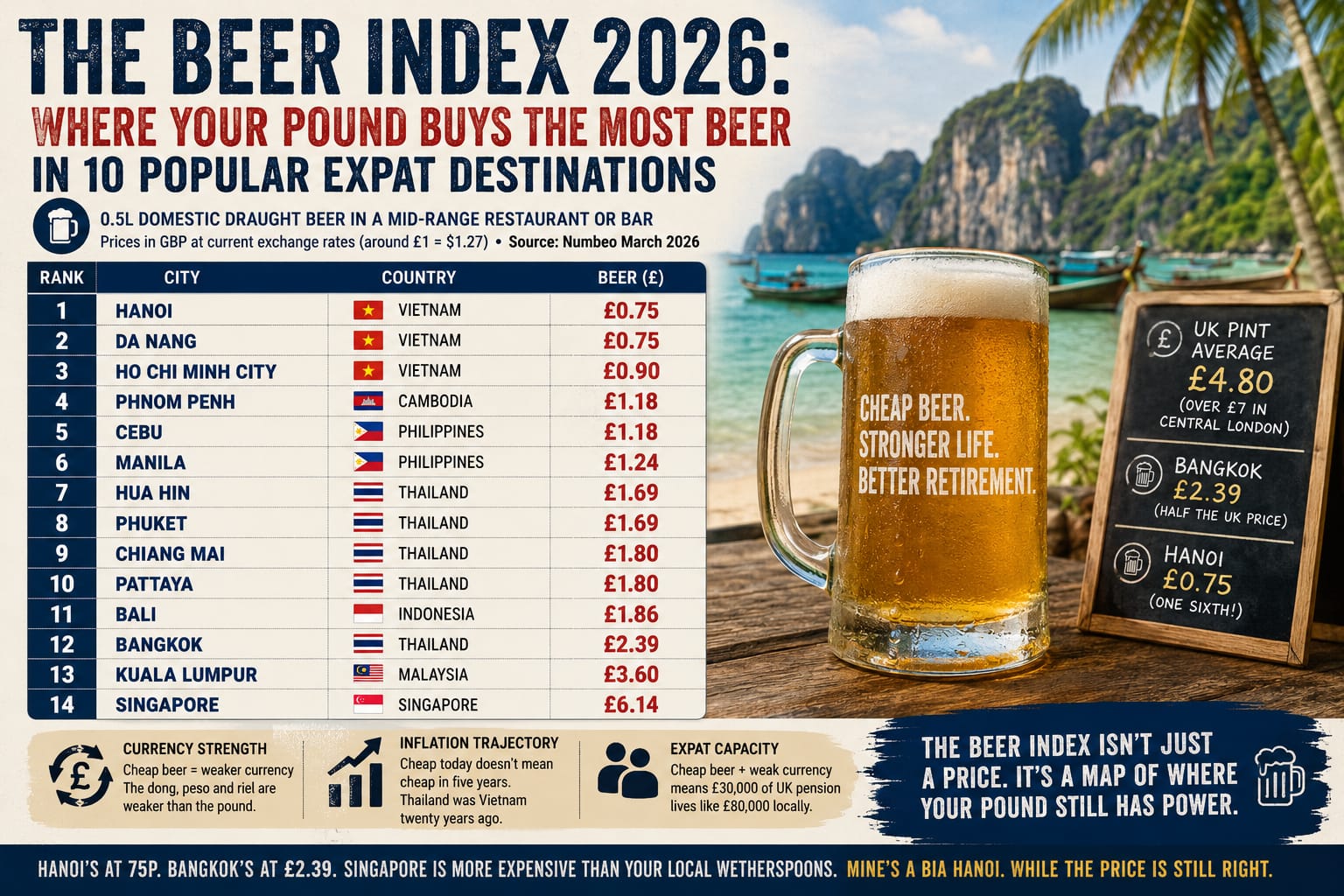
Welcome to the Pad Thai Index. The follow-up to last week's Beer Index, and arguably the more important one, because nobody retires abroad on beer.
Why pad thai is the right benchmark
The Big Mac Index works because a Big Mac is identical everywhere. The same beef patty, the same bun, the same machine slicing the cheese. McDonald's standardisation is the whole point.
Pad thai is the opposite kind of benchmark. It's not standardised. It's not industrial. It's made by hand, every day, by thousands of small operators across Thailand, using local ingredients: rice noodles, eggs, bean sprouts, tamarind, fish sauce and peanuts. When the price moves, it tells you something real about the Thai economy, not something a global supply chain decided in a boardroom in Chicago.
It's the dish a British tourist actually eats. It's the dish a British expat actually buys. Tracking its price in sterling tells you what your money does on the ground, not what an FX chart says it should do.
The 20-year breakdown
Here's the maths, in detail.
2005: pad thai at a street stall cost 25 baht. GBP/THB was around 72. Cost in sterling: 35p.
2010: pad thai had crept up to 35 baht. GBP/THB had dropped to about 48 after the 2008 financial crisis battered sterling. Cost in sterling: 73p. Already double 2005, just five years in.
2015: 45 baht. GBP/THB around 53. Cost in sterling: 85p. The baht had recovered slightly against sterling, but Thai inflation kept pushing the dish up.
2020: 55 baht. GBP/THB around 39 in the worst pandemic months. Cost in sterling: £1.41.
2026: 80 baht. GBP/THB at 43. Cost in sterling: £1.86.
So your 35p breakfast became a £1.86 breakfast. Five times more, in real money, for the same plate. If a Brit ate pad thai every weekday for a year in 2005, it cost them about £91. The same routine today costs £484. That's £393 extra a year, just on breakfast, just to do what they were already doing.
The two forces, again
This is the same story as the Beer Index, but the proportions are different and worth understanding.
The baht price of pad thai roughly tripled over twenty years, from 25 to 80 baht. That's Thai food inflation, driven by rising labour costs, higher input costs, and the slow gentrification of street food culture. Some old-school carts have become small restaurants with menus and aircon.
The pound's baht-buying power roughly halved, from 72 to 43. That's the FX move, driven by everything sterling has done over twenty years: the 2008 crash, Brexit, the Truss budget, the structural decline of UK relative GDP.
Multiply tripled price by halved currency power, and you get the 5x. Same outcome as the Beer Index, slightly different mechanics. Pad thai inflated harder in baht terms than beer did, because the labour content of cooked food is higher than the labour content of a bottled drink.
This is one of the underrated lessons of the Index series. Different products inflate at different rates in the same country. Beer mostly inflates because of tax and import costs. Cooked food inflates because of wages. Rent inflates because of land. Services inflate because of all three. The headline CPI number Thailand publishes every month hides all of this.
Where pad thai is still cheap in sterling
If you want to track the Pad Thai Index across Southeast Asia, here's where the 2026 figures land for a standard plate at a casual local restaurant or street stall, converted to GBP at current rates:
| City | Local price | GBP cost |
|---|---|---|
| Hanoi (phở as equivalent) | 50,000 VND | £1.55 |
| Phnom Penh (lok lak as equivalent) | $3 | £2.36 |
| Bangkok (pad thai) | 80 baht | £1.86 |
| Hua Hin (pad thai) | 70 baht | £1.63 |
| Chiang Mai (khao soi as equivalent) | 60 baht | £1.40 |
| Manila (adobo as equivalent) | ₱120 | £1.65 |
| Kuala Lumpur (nasi lemak as equivalent) | RM12 | £2.07 |
| Bali (nasi goreng as equivalent) | Rp35,000 | £1.66 |
| Singapore (hawker centre dish) | S$6.50 | £3.78 |
Notice Chiang Mai. £1.40 for a bowl of khao soi, arguably the best dish Thailand produces. That's why Chiang Mai stays at the top of British expat retirement lists year after year. The Beer Index there is middling but the Food Index is excellent, and food is what you eat three times a day for the rest of your life. If you are deciding where that cheaper routine should happen, start with Chiang Mai vs Hua Hin and Chiang Mai vs Pattaya.
Notice Singapore. £3.78 for a hawker centre meal. Hawker food is supposed to be Singapore's cheap option, the people's food. It's now more expensive than a UK supermarket meal deal.
What this tells you about retirement maths
If you're a British retiree weighing up Thailand vs Vietnam vs Spain vs staying home, the Pad Thai Index gives you a quick triangulation.
Three meals a day at £1.86 each is £5.58. Across 365 days that's £2,037 a year on food, eating out at local prices, every meal, for a year. That's less than most British retirees spend on a weekly Tesco shop multiplied across the same period: £60/week = £3,120/year, and that's before you've eaten out at all.
The food saving alone, on a Thai retirement, is roughly £1,000-1,500 a year compared to a UK budget. Multiply across a 20-year retirement and you're looking at £20-30k. That's a kitchen extension. A car. A small flat deposit for one of your kids.
But here's the bit the Pad Thai Index makes obvious. The savings are shrinking. In 2005 the same comparison would have shown food costs of about £380 a year for three meals daily at street prices. That's £2,740 a year saved against a UK shop, every year, compounding.
The retirement-abroad dream got 5x weaker over twenty years. Not 50% weaker. 5x weaker. And almost nobody has updated their mental model.
The Vietnam shortcut
Run the same maths on Hanoi at £1.55 per meal and the numbers look like Thailand in 2010. A Brit eating three meals a day at local prices in Hanoi spends about £1,697 a year on food. That's a £1,400-ish annual saving against a UK shop, in 2026 prices.
It's not the £2,740 saving of 2005 Thailand. But it's a hell of a lot more than the £1,000 saving of 2026 Thailand.
If you've been reading this series and you've started doing the maths on Vietnam, congratulations, you've understood the assignment. The Pad Thai Index and the Beer Index are both pointing at the same conclusion: the smart sterling holders are looking one country to the east of where the brochures point them.
The closer
Pad thai isn't just a dish. It's a yardstick. For twenty years it has quietly measured what sterling does in Thailand better than the GBP/THB chart, the Bank of England inflation report, or any expat YouTube channel.
The dish hasn't changed. The wok hasn't changed. The recipe hasn't changed. What's changed is everything around it, and everything around your money.
If you're planning to retire abroad on a UK pension, do this one exercise. Pick the dish you'd eat most often. Look up its 2005 price and its 2026 price in local currency. Convert both to sterling at the FX rates of each year. Look at the multiplier.
Whatever number you get, that's the size of the gap between the retirement you imagined and the retirement you'd actually have.
Mine, in pad thai, is 5.3x.
Yours might be different. But it won't be smaller.