Fourteen days. Twelve cities. Seven indices. One question.
Where do all these numbers go in 2030?
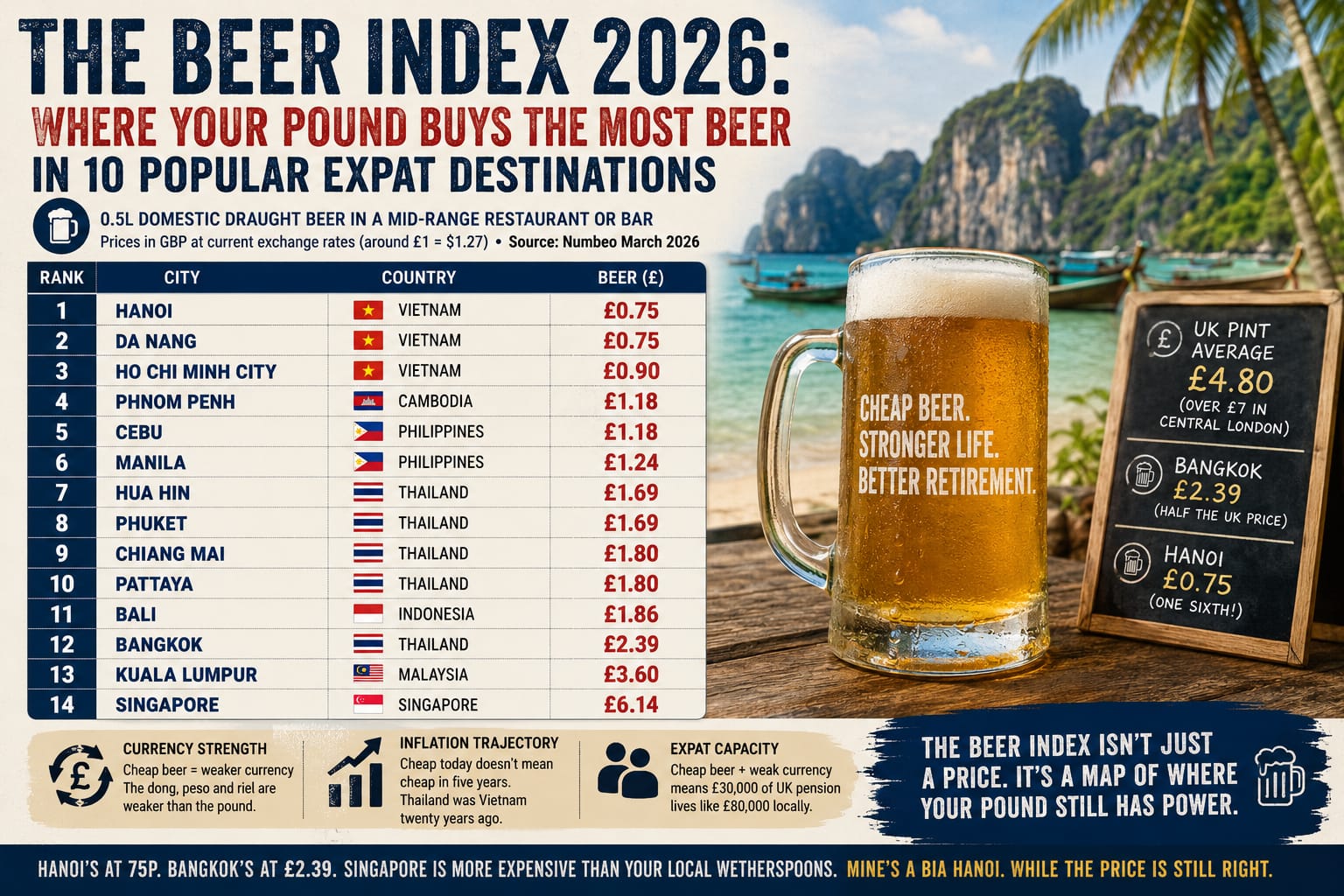
This series started with a Chang on a Patong beach: 56p in 2005, £2.79 in 2026. A five-times increase that almost nobody had noticed. We built outward from there. The Pad Thai Index. The Coffee Index. The Taxi Index. The Rent Index. The Haircut Index. The Massage Index. The Trilemma. The £100 day. The Vietnam Window. The Bangkok Middle Class Trap. The Bali Paradox. The British Retiree’s Portfolio.
Each piece told a piece of the same story. The geography of “cheap Asia” is moving, and faster than most people realise.
Today, the closing piece. Where the numbers land in 2030. What it means for the £1 in your pocket. And the four concrete moves a British retiree or remote worker should make in 2026 to lock in what’s still available.
This is the forecast. Then the action.
The 2030 Beer Index, city by city
We start where we started. The pint of beer. Half-litre, mid-range bar, in sterling. Today’s figure, then the 2030 forecast based on the trends laid out across this series.
| City | Beer 2026 | Beer 2030 (forecast) | Change |
|---|---|---|---|
| Hanoi | £0.75 | £1.25 | +67% |
| Da Nang | £0.75 | £1.20 | +60% |
| Ho Chi Minh City | £0.90 | £1.45 | +61% |
| Phnom Penh | £1.18 | £1.65 | +40% |
| Cebu | £1.18 | £1.55 | +31% |
| Manila | £1.24 | £1.65 | +33% |
| Hua Hin | £1.69 | £2.10 | +24% |
| Phuket | £1.69 | £2.15 | +27% |
| Chiang Mai | £1.80 | £2.25 | +25% |
| Pattaya | £1.80 | £2.20 | +22% |
| Bali | £1.86 | £2.60 | +40% |
| Bangkok | £2.39 | £2.95 | +23% |
| Kuala Lumpur | £3.60 | £4.20 | +17% |
| Singapore | £6.14 | £6.95 | +13% |
A few observations.
Vietnam moves the fastest. The dong is structurally pressured to strengthen, local wages are catching up to Thai levels, and the expat economy is forming around the major cities. Hanoi 75p becomes Hanoi £1.25 by 2030. Still cheap. Not transformatively cheap.
Thailand moves slowly because it’s already moved. The middle income trap suppresses wage growth. Tourist pricing has already peaked in baht terms. The pound’s continued weakness against the baht will do most of the price-rise work in sterling terms, not local inflation. Bangkok goes from £2.39 to £2.95, a modest move.
Singapore and KL move least. They’ve already converged with global pricing. There’s less room for relative inflation. Singapore’s beer rises with global consumer prices, not Asian-emerging-market dynamics.
Bali moves fast despite Indonesian inflation being low. This is the foreign-demand-detachment story. Bali isn’t moving with Indonesia. It’s moving with Australian and European nomad demand, which is still rising.
The 2030 Rent Index
Rent is the biggest line in any monthly budget, and the canary in the cost-of-living mineshaft. Where one-bedroom central rents land in 2030.
| City | Rent 2026 | Rent 2030 (forecast) | Change |
|---|---|---|---|
| Hanoi | £352 | £550 | +56% |
| Da Nang | £418 | £620 | +48% |
| Chiang Mai | £429 | £550 | +28% |
| Cebu | £442 | £580 | +31% |
| Manila | £473 | £620 | +31% |
| HCMC | £485 | £720 | +48% |
| Hua Hin | £497 | £620 | +25% |
| Kuala Lumpur | £554 | £670 | +21% |
| Phnom Penh | £557 | £730 | +31% |
| Bangkok | £574 | £700 | +22% |
| Phuket | £591 | £730 | +24% |
| Bali (Canggu) | £900 | £1,300 | +44% |
| Tokyo | £1,022 | £1,200 | +17% |
| Hong Kong | £1,889 | £2,150 | +14% |
| Singapore | £2,349 | £2,700 | +15% |
The story is the same. Vietnam moves fastest. By 2030, Hanoi rent has crossed £500 and Saigon has crossed £700. The “Vietnam Window” that’s open today is functionally a Bangkok-equivalent by 2030, then a Bangkok-2018-equivalent by 2035.
Critically: by 2030, the gap between Hanoi (£550) and Chiang Mai (£550) has closed entirely. This is the moment the Vietnam Window stops being structurally different from the Thailand Window. The arbitrage that exists in 2026 between the two countries simply disappears by 2030.
If you’re not in Vietnam capturing the arbitrage by 2028, you won’t see it. By 2030, you’ll be paying Thai prices for a Vietnamese lifestyle, which is a worse deal than just being in Thailand.
The cumulative damage to sterling
Pull all seven indices together and run the cumulative cost of a typical Brit’s month in each city. This is the figure that actually matters for retirement planning.
For a comfortable expat or retiree lifestyle (one-bed central, three meals a day mostly local sometimes Western, weekly massage, daily coffee, several beers, regular taxis):
| City | Monthly cost 2026 | Monthly cost 2030 | Change |
|---|---|---|---|
| Hanoi | £1,040 | £1,520 | +46% |
| HCMC | £1,180 | £1,720 | +46% |
| Da Nang | £1,090 | £1,580 | +45% |
| Cebu | £1,290 | £1,650 | +28% |
| Manila | £1,380 | £1,760 | +28% |
| Chiang Mai | £1,420 | £1,750 | +23% |
| Phnom Penh | £1,460 | £1,890 | +29% |
| Hua Hin | £1,570 | £1,920 | +22% |
| Phuket | £1,720 | £2,090 | +22% |
| Bangkok | £1,800 | £2,150 | +19% |
| Bali (Canggu) | £2,100 | £2,800 | +33% |
| Kuala Lumpur | £1,890 | £2,200 | +16% |
| Tokyo | £2,400 | £2,720 | +13% |
| Hong Kong | £3,200 | £3,580 | +12% |
| Singapore | £3,650 | £4,050 | +11% |
For the comfortable retiree on £24,548/year (£2,046/month), 2026 vs 2030 changes the maths significantly.
In 2026:
- Vietnam: living on 51% of income, saving £1,000/month
- Thailand: living on 70-88% of income, saving £250-£625/month
- Singapore: living on 178% of income, going backwards
In 2030 (assuming pension grows in line with UK inflation, roughly 2-2.5% annually, to £27,000/year or £2,250/month):
- Vietnam: living on 68-76% of income, saving £530-£730/month
- Thailand: living on 78-96% of income, saving £100-£500/month
- Singapore: living on 180% of income, still going backwards
The Vietnam arbitrage halves over five years. The Thailand arbitrage drops by roughly 40%. Neither disappears. Both shrink meaningfully.
For a Brit considering the move, this is the number that matters. Every year you delay starting an Asia retirement reduces your lifetime savings by approximately £6,000-£8,000. Compounded across the 20-year retirement, delaying from 2026 to 2030 costs you roughly £40,000-£60,000 in opportunity cost.
Why the trajectory is structural, not cyclical
A reasonable challenge to all this forecasting: maybe the pound recovers. Maybe Asian growth slows. Maybe the trends reverse.
Honest answer: it’s possible, but unlikely at any timescale that matters for retirement planning. Here’s why.
The pound’s structural problems are deep. The British Chambers of Commerce’s June 2026 forecast put UK GDP growth at 0.9% for 2026, with business investment still struggling. UK productivity has barely grown in 15 years. The current account is in persistent deficit. The fiscal position is constrained. None of this gets fixed quickly. Sterling will not strengthen meaningfully against Asian currencies in the next five years. Could it have a cyclical bounce? Yes. Will it return to 72 baht? No.
Asian growth is structural. Vietnam is on a clear trajectory from $5,000 GDP per capita to $8,000+ by 2030. That’s wage growth, services inflation, and currency strength all at once. Thailand has stalled but is still slowly converging. The Philippines is at the early-Thailand stage of its development cycle. None of these countries are going backwards. They’re all getting more expensive in sterling terms, year after year.
Tourism and digital nomad inflows are accelerating, not slowing. Post-COVID remote work normalisation, the rise of digital nomad visas, the explicit attraction strategies of Asian governments (Vietnam’s Golden Visa pilot, Thailand’s LTR, Philippines’ SRRV) are all driving more foreign demand into these economies. More foreign demand always drives prices up.
The UK is not going to lower its inflation to below Asian inflation any time soon. Even with the Bank of England targeting 2% CPI, structural cost pressures (energy, housing, labour shortages) keep the real consumer experience inflating. Meanwhile Asian inflation in services is running 5-10% annually in the fast-growing markets. The gap is structural, not cyclical.
The forecast above is conservative. The actual numbers in 2030 might be higher.
The four moves to make in 2026
If the forecast is roughly right, then the rational response is to act now. Not “think about it for two more years and decide.” Act. Four specific moves.
Move one: open the FX infrastructure.
Today. This week. Open a Wise multi-currency account if you don’t have one. Open a Currencies Direct account as a backup. Add GBP, THB, VND, PHP balances even if they’re £0 to start. You want the rails in place before you need them.
The day you actually need to send £15,000 to a Thai landlord for a year’s rent in advance is not the day to be opening accounts. Wise verification can take 5-10 days. International receiving accounts need address verification. Set this up while you have time to do it calmly.
Move two: take a recon trip.
Three weeks. Two cities. One country.
Don’t fly to “Asia” generally. Don’t visit five cities in three weeks. Pick one country, ideally Vietnam if you’re 50-65, ideally Thailand if you’re 65+. Spend ten days in one city, ten in another. Eat in normal places. Take normal taxis. Walk through normal neighbourhoods. Don’t stay in hotels above £80/night.
You’re not doing tourism. You’re doing due diligence. Test whether the cost of living numbers in this series feel right when you’re actually paying them. Test whether the heat, the food, the cultural distance, the language barrier feel manageable for a multi-month stay. Test whether you can imagine doing this six months a year.
Most British retirees who skip this step and commit to a long stay regret it. Most who do it find their actual answer fast.
Move three: get the UK pension forecast and the visa requirements aligned.
Run your UK State Pension forecast (gov.uk/check-state-pension, ten minutes, free).
Calculate your realistic post-65 income: State Pension + private pension drawdown + ISA income + rental income from any UK property you might keep.
Check the visa requirements for your target country: Thailand LTR needs $80,000 annual income or $250,000 in assets. Thailand retirement visa needs 800,000 baht in a Thai bank or 65,000 baht monthly income. Vietnam doesn’t have a formal retirement visa yet but the Golden Visa pilot is launching in 2026. Philippines SRRV needs $10,000-$20,000 deposit depending on age.
Match your projected income to a visa pathway today, not in five years. If you don’t qualify yet, you have time to fix it (extra NI contributions, higher pension drawdown structure, ISA build-up).
Move four: start the actual portfolio in 2027-2028, not 2030.
If you’re 55-60 today, your action year is 2027. If you’re 60-65, your action year is 2026 or early 2027. If you’re 65+, your action year is now.
The biggest financial mistake British retirees make about Asia is delaying. They think about it for five years, do a holiday, think for another two years, do another holiday, and finally move at 70 when the Vietnam Window has half-closed and their adaptability has decreased.
Every year you delay reduces your usable Asia retirement by one year on the front end (when you’re healthiest and benefit most) and reduces the total arbitrage by 8-10% (because the windows are closing). The combined effect is roughly £8,000 of lost lifetime value per year of delay.
If you’ve read all 14 days of this series and you’re convinced enough to consider it, the question stops being “should I?” and becomes “when?”. The honest answer is: sooner than you’re currently planning.
What the next chapter of this publication covers
This is the close of the original 14-day Beer Index series. But it’s the opening of a larger publication.
The Education Pillar (12 pieces, starting next week): what international schools cost across 10 Asian cities, who actually owns them (spoiler: Canadian pension funds and Swedish private equity), what teachers earn, and how British expat families should actually navigate the system.
The Healthcare Pillar (8-10 pieces): the medical care question that determines whether a Brit can age in Asia or has to come home in their 80s. Insurance options, hospital quality, costs, the genuinely difficult bits.
The Property Pillar (6-8 pieces): the rent-vs-buy question, the foreign ownership rules in each country, the property scam landscape, the actual maths of holding Asian property.
The Pension and Tax Pillar (6-8 pieces): how to actually structure a UK pension drawdown for Asia residence, the tax treaty implications, when to keep UK tax residence and when to formally leave.
This series gave you the prices. The pillars give you the strategy. The same authorial voice. The same commitment to real numbers and honest assessment. The same belief that British retirees and remote workers deserve better than brochure-grade content about their biggest life decisions.
If you’ve read this far, the publication is for you. Subscribe to the Baht Brief at thebaht.com for the weekly digest.
The takeaway
Three things to take from 14 days of data.
One: the cheap-Asia story is real but narrow. Vietnam in 2026 is genuinely transformatively cheap for a British retiree. By 2030 it’s not. By 2035 it’s roughly where Thailand is today. The window is real and it’s closing on a five-year timeline.
Two: the three-city portfolio approach beats single-city commitment. Anchor in Chiang Mai for healthcare and visa stability. Capture value in Hanoi or Da Nang. Maintain optionality through Cebu. Use Wise or Currencies Direct for FX. Rent everywhere, own nowhere, for at least five years.
Three: act now. Every year of delay reduces lifetime arbitrage by £8,000+. If you’re 55-65 and seriously considering this, your moves are: open the FX infrastructure this month, take a proper recon trip this year, match your income to a visa pathway, and start the actual portfolio within 18-24 months.
The pound still has power. The geography keeps moving. The strategy is to move with it, before it moves away.
Mine’s a £0.75 Bia Hanoi at Ta Hien Street with the knowledge that by 2030 it’ll be £1.25 and the conversation will be about the next country. Cambodia maybe. Or the Philippines outside Manila. Or somewhere we haven’t thought of yet.
The Beer Index keeps moving. So do we.
Thank you for reading the first fourteen days. The next fourteen start tomorrow.