Nine days into this series, one country keeps winning every Index we run.
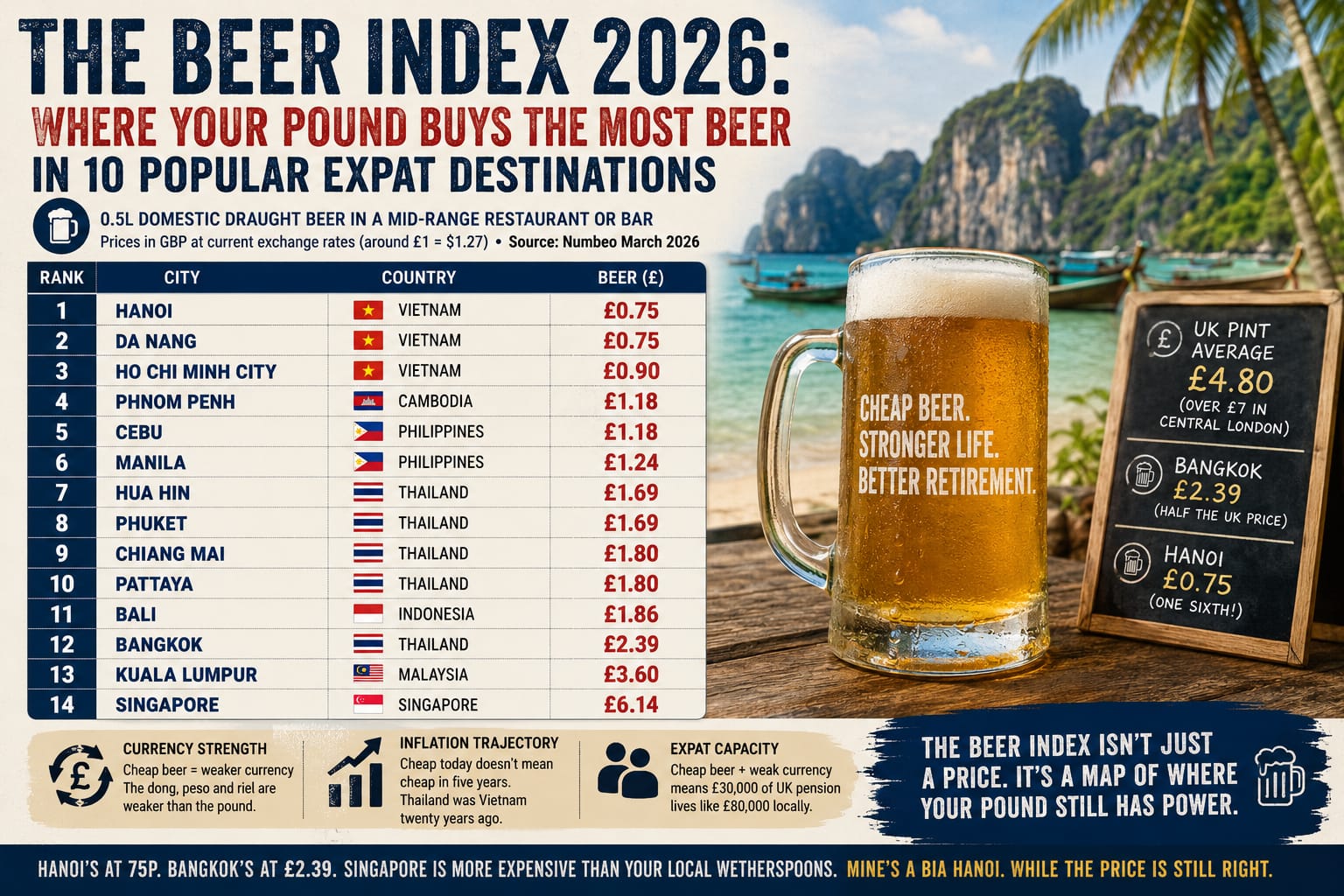
Beer in Hanoi: £0.75. Cheapest in Southeast Asia.
Phở in Hanoi: £1.55. Same.
Coffee in Hanoi: £2.06. Same.
Taxi in Hanoi: £0.46/km. Cheapest of all major cities.
Rent in Hanoi: £352/month for a central one-bed. Cheapest of all the expat destinations we tracked.
Haircut in Hanoi: £0.95 at a street barber, £6.35 at a salon. Cheapest.
Massage in Hanoi: £6.35. Among the cheapest.
Vietnam isn’t just the cheapest country in Southeast Asia for a British expat in 2026. It’s the cheapest by a wide margin, across every category we’ve measured. And it’s the only country where the pound still buys what it bought in Bangkok twenty years ago.
But here’s the question that should keep anyone considering a move awake at night. How long does this last?
The answer is the most important number in this entire series: roughly five years. After that, the Vietnam Window closes, and the next cheap-beer country will be somewhere else entirely.
This is the investment thesis. Here’s the data behind it.
What makes a “window” a window
A cost-of-living window opens when a country has four things at once:
One, a structurally weak currency that buys little against sterling.
Two, low local wages that price the entire services economy at a discount.
Three, infrastructure good enough to live comfortably (working internet, hospitals, supermarkets, payment systems).
Four, an established expat presence that makes life navigable without speaking fluent local language.
The window closes when any of those four conditions break. Usually they all break together, in a slow cascade over 10-20 years, as the country develops out of the cheap tier.
Thailand had this window from roughly 1995 to 2015. Brits caught the second half of it. By 2020 the window was clearly closing. By 2026, as we’ve documented across this series, it’s closed. Thailand is still cheaper than the UK. It’s no longer transformatively cheaper.
Vietnam has the same window open right now. It’s been open since roughly 2018 and it’s closing fast.
The 2025 inflection point
Here’s what made 2025 the year the Vietnam story became impossible to ignore for serious expat planners.
Vietnam’s economy grew 8.02% in 2025. That’s the fastest annual growth since 2009, excluding the volatile post-COVID rebound. The fourth quarter of 2025 hit 8.46% year-on-year. The government has set a target of 10% growth for 2026, and BIDV’s chief economist, plus several international banks, are forecasting that’s achievable.
GDP per capita crossed $5,000 in 2025. That’s the threshold the World Bank uses to define “upper-middle-income.” Vietnam is no longer a developing country in any meaningful sense. It’s an industrialising country at the inflection point where prices start ratcheting up to global middle-class norms.
For context, Thailand crossed the same threshold in roughly 2010. The Thailand of 2015-2026 (the era of price increases we’ve documented) is what Vietnam is starting now.
This isn’t speculation. It’s the same pattern, fifteen years later, with better data and a clearer trajectory.
What the cheap-side currently looks like
Let’s anchor the Vietnam case in the actual numbers, because the cumulative effect is what makes the argument.
A British digital nomad or early retiree in Hanoi can currently live like this:
- Modern one-bed apartment, central, with West Lake or Old Quarter access: £352/month
- Three meals a day, mostly local, sometimes Western: £180/month
- Coworking space membership: £80/month
- Weekly Thai-style massage at a Vietnamese spa: £25/month
- Daily coffee at a specialty café: £45/month
- 4-5 taxis a week: £55/month
- Weekend trips, occasional drinks out, entertainment: £180/month
- Health insurance (private, decent quality): £45/month
- Phone, internet, utilities, miscellaneous: £80/month
Total: about £1,040/month.
That’s £12,480 a year for a comfortable life in a major Asian capital with everything a Brit could want. The same lifestyle in Bangkok costs roughly £1,800/month. In Singapore £4,000+. In London £3,500-£4,500.
For a British retiree on a £24,000/year combined pension and savings drawdown, Vietnam offers a 50%+ saving compared to Thailand, and a 70%+ saving compared to the UK. For a digital nomad earning £40,000/year remote, Vietnam means they save £25,000+ a year compared to staying in London.
This is the structural arbitrage. The Vietnam Window in real numbers.
How fast the window is closing
Now the uncomfortable bit. The arbitrage above doesn’t survive Vietnam’s growth trajectory. Here’s why.
The dong is structurally pressured to strengthen. Vietnam runs current-account surpluses. Foreign direct investment hit record levels in 2025 ($25+ billion disbursed). Manufacturing exports surged 17% year-on-year. All of this puts upward pressure on the dong. The State Bank of Vietnam has been managing this, intervening in FX markets to keep the dong weak enough to maintain export competitiveness. But the structural pressure is one-way: stronger dong, weaker pound buying power.
Local wages are rising fast. When GDP per capita grows from $4,000 to $5,000 in five years, wages in the services sector rise with it. The masseuse who currently earns 8m VND/month (£250) will earn 14-16m VND/month by 2030. Her hourly rate doubles. Your £6 massage becomes a £12 massage. Same service, same hands, twice the price.
Rent is rising fastest. Hanoi and HCMC central rents have already increased 30-40% since 2020. The new metro lines in both cities are pushing prices outward as commuter belts develop. The good central one-bed at £352 today will be £450-£550 within three years and £700+ within seven. This is exactly what happened to Bangkok between 2010 and 2020.
The expat premium is forming. Restaurants in Tay Ho and Thao Dien are already operating dual-pricing in practice (a “Western menu” at 2x local prices). Specialty coffee shops in expat-heavy areas charge close to Bangkok prices. Coworking spaces in central HCMC are at $200/month, up from $120 just two years ago. The tourist/expat economy is starting to detach from the local economy, exactly as it did in Thailand a decade ago.
The visa regime is liberalising. Vietnam introduced 90-day e-visas in 2023, extended visa-free entry to 13 countries (including the UK) for 45 days in 2024, and is piloting a Golden Visa programme in 2026 aimed at retirees, professionals, and remote workers. Every visa liberalisation accelerates the inflow of foreign money, which accelerates price inflation in the services economy.
Put all four trends together and you get the same trajectory Thailand followed between 2005 and 2020. The pace might be faster, given Vietnam’s higher GDP growth rate and the established global digital nomad infrastructure that didn’t exist when Thailand was at this stage.
The five-year estimate
Here’s the maths on the closing window.
Vietnam GDP per capita 2025: $5,026.
At 8-10% annual growth, GDP per capita in 2030: $7,300-$8,000. Roughly where Thailand was in 2018.
At the same point, expect:
- Hanoi one-bed central rent: £550-£650/month (currently £352)
- Bangkok-style coffee shop pricing: £3.50+ flat white (currently £2.06)
- Thai-equivalent restaurant pricing in expat districts: £8-£12 mains
- Mid-tier massage: £12-£15 (currently £6.35)
- Total digital nomad monthly budget for the same lifestyle: £1,500-£1,700 (currently £1,040)
That’s a 50% real-terms increase in sterling cost over five years. Vietnam will still be cheaper than Thailand. It won’t be transformatively cheaper. The arbitrage will halve.
By 2035, the window is functionally closed. Vietnam will be where Thailand is today. The digital nomad mecca will have moved on, probably to Cambodia, Laos, Myanmar, or possibly the Philippines outside Manila.
Anyone who wants to lock in the 2005-Thailand experience for their fifties, sixties, or remote-work decade should be making the move within the next five years. After that, they’re paying for the closing premium and getting half the benefit.
Where the smart British money is moving
Here’s an observation that hasn’t shown up in mainstream UK media yet. British retirees who already moved to Thailand are starting to migrate to Vietnam.
The pattern: 60-something British man, moved to Hua Hin or Chiang Mai in 2008-2015, watched prices climb steadily, took a holiday in Hanoi in 2023, did the maths on the ground, and is now spending 6-9 months a year in Vietnam and 3-6 in Thailand. Some have gone full-time Vietnam.
The reasons are simple. The same UK pension that bought comfort in 2010 Thailand buys a stretched lifestyle in 2026 Thailand. The same pension buys 2010-Thailand-comfort in 2026 Vietnam. They’re chasing the experience, not the country.
This is what cost-of-living arbitrage looks like in real life. The geography moves, but the maths stays the same.
The risks (because there always are some)
Honesty matters. The Vietnam case isn’t risk-free.
Healthcare quality is uneven. Major hospitals in Hanoi and HCMC have decent international wings (FV Hospital in Saigon, Vinmec in Hanoi). Provincial healthcare is more limited. For retirees with significant chronic conditions, Bangkok’s healthcare ecosystem is still better than anywhere in Vietnam.
Language is a real barrier. The EF English Proficiency Index puts Vietnam at #64 globally, “Moderate Proficiency.” That’s better than Thailand (#116) but worse than the Philippines (#28) or Singapore. Outside tourist and expat areas, you’ll struggle without basic Vietnamese.
Air quality in Hanoi is genuinely poor. Winter months see AQI readings above 200 routinely. For respiratory-sensitive retirees, this is a serious consideration. Da Nang and HCMC have better air quality.
Property ownership is restricted for foreigners. You can lease for 50 years, you can own apartments in licensed buildings, but you cannot own land. This is a structural difference from Thailand and means most expats rent, which exposes you to rising rents over time.
Political risk is real but manageable. Vietnam is a one-party state. The system is stable but opaque. Foreigners are welcomed for their money but have limited legal recourse if things go wrong. This isn’t a country to bring large business operations into without local partners.
None of these risks are deal-breakers for someone doing a 5-10 year arbitrage play. They’re things to be aware of, not reasons to dismiss the case.
The Cambodia and Laos shadow
One more honest note. Cambodia is currently cheaper than Vietnam on most line items. Phnom Penh beer £1.18, taxis £0.79/km, rent £557/month. Laos is cheaper still.
So why isn’t this article about Cambodia or Laos?
Three reasons. Cambodia’s economy is smaller and more volatile. It depends heavily on Chinese investment and tourism, and currency stability is less reliable than Vietnam. Healthcare and infrastructure are notably weaker. The expat community is much smaller, especially for British nationals. The combined effect is that Cambodia is cheaper in headline terms but less liveable for most British retirees.
Vietnam is the sweet spot. Cheap enough for the arbitrage to be transformative. Developed enough for daily life to work. Established enough that there’s a functioning British expat community in Hanoi, HCMC, and Da Nang.
Cambodia is the next window after Vietnam. Anyone who’s been to Phnom Penh recently can see it forming. But it’s a 5-10 year later window. For most British readers in their fifties or sixties, Vietnam is the play.
The takeaway
Three concrete things follow from the data in this article.
One: if you’re a British retiree currently considering Thailand based on memories from 2005-2015, look at Vietnam first. The numbers favour Vietnam by 40-60% across every category, and the experience is closer to what Thailand was when you fell in love with it.
Two: if you’re a digital nomad or remote worker thinking about a multi-year Asia base, Vietnam is the highest-arbitrage option in 2026. £1,000/month vs £2,000/month Bangkok or £3,500/month Singapore. Over a five-year stretch, you save £60,000-£150,000. That’s a house deposit. That’s early retirement money.
Three: the window is five years, not fifty. The data on Vietnam’s growth, currency, and expat inflow is unambiguous. By 2030 Vietnam will be the new Thailand. By 2035 the cheap-beer story has moved somewhere else entirely.
If you want the 2005-Thailand experience back, you’ve got until roughly 2030 to lock it in. After that, it’s gone.
The pound still has power. The geography just keeps moving. Right now, the geography points to Hanoi.
Mine’s a £0.75 Bia Hanoi at Ta Hien Street, sitting on a plastic stool, watching the world change. The price is still right. For now.