Yesterday’s piece made the case for Vietnam. Five years to lock in the 2005-Thailand experience before the window closes.
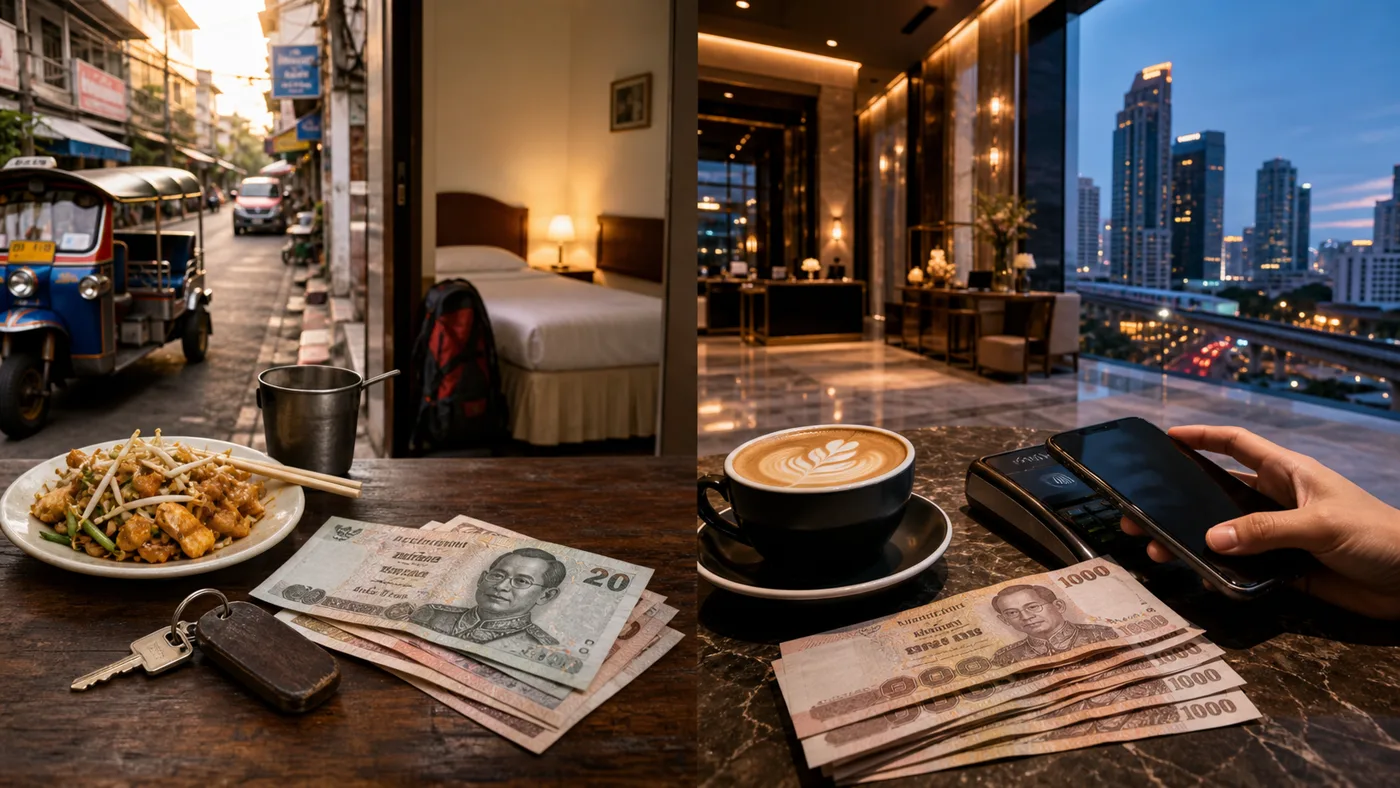
Today’s piece is the warning that comes with it. Thailand didn’t just stop being cheap. It stopped being dynamic. Prices kept rising. Wages kept rising. But growth collapsed. The country got more expensive without getting much better, and that’s the trap waiting for Vietnam at the end of its next decade.
Anyone making a 10-20 year decision about Southeast Asia needs to understand this trap before they sign the lease.
This is the Bangkok Middle Class Trap.
What actually happened to Thailand
Let’s tell the Thai economic story in three numbers.
1960-1996: GDP growth averaged 7.5% per year. Thailand was one of the original Asian Tigers. Per capita income went from $200 to $3,000 in three and a half decades. Bangkok transformed from a riverside city into a global capital.
1999-2005: After the 1997 Asian Financial Crisis, growth recovered to 5% per year. This was the era we’ve documented in this series. £100 buying you a full day in Bangkok with change. 40-baht beach beers. 80-baht haircuts. The era British retirees and backpackers still talk about. This was the Thai miracle in its second-wave form.
2015-2026: GDP growth dropped to 1.5-2.5% per year. In 2025, Thailand grew at 2.4%. In 2026, the World Bank projects 1.8%. The economy didn’t crash. It just stopped progressing meaningfully. GDP per capita went from $6,400 in 2024 to a projected $8,105 in 2026, but the headline number hides the stagnation underneath.
This is the middle income trap. A country graduates from poverty to middle-class, then gets stuck. Wages are too high to compete with cheaper neighbours. Education and innovation aren’t strong enough to compete with richer ones. The economy crystallises in the middle, and growth slows to a crawl.
Thailand crossed into upper-middle-income status in 2011. The OECD’s 2025 Economic Survey of Thailand was blunt: “Catch-up in GDP per capita has slowed, and the pace of poverty reduction has diminished.” The Bank of Thailand projects per capita growth of around 2% for the foreseeable future. The country isn’t getting richer, it’s just getting older.
Why this matters for British expats
Here’s the bit that doesn’t get talked about in the Thailand retirement YouTube videos. The middle income trap creates a specific kind of cost-of-living problem for foreign retirees that’s different from being in a poor country or a rich one.
In a poor country: services are cheap because wages are low. You get massive arbitrage. Vietnam in 2026. Thailand in 2005.
In a rich country: services are expensive because wages are high, but quality is also high. You pay London prices for London-quality. Singapore. Tokyo. UK retirement.
In a middle income trapped country: services are increasingly expensive because wages rose to middle-income levels, but the quality of services, infrastructure, and governance often hasn’t caught up. You pay rising prices for stagnating quality. This is the worst combination for a foreign retiree.
Specific examples from Thailand 2026:
Hospitals: a private check-up at Bumrungrad now costs 50-70% of UK private equivalent. Quality is decent but variable. The cheap-and-good era is gone. The expensive-and-excellent era hasn’t arrived.
Property: Bangkok condo prices have doubled in baht over fifteen years. Foreign buyer fees, transfer taxes, and minimum-purchase rules have all tightened. The £150,000 sea-view condo of 2010 is £280,000 in 2026, and the resale market is weak.
Visas and bureaucracy: the visa system has gotten more expensive (the 2024 Long-Term Resident visa is 50,000 baht just to apply) but no less bureaucratic. You pay more for the same paperwork friction.
Healthcare insurance for retirees: mandatory coverage requirements have tightened, and the insurance market has consolidated. Annual premiums for a 65-year-old now run 80,000-150,000 baht. That’s £1,860-£3,490, on top of all other costs.
Banking: opening accounts as a foreigner has gotten harder. Many banks now require proof of long-term visa, work permit, or a Thai guarantor. The casual expat banking experience of 2010 is gone.
The cumulative effect: a Thai retirement in 2026 costs roughly 60-70% of a UK retirement, depending on lifestyle. In 2005 it cost roughly 20-25%. The arbitrage has shrunk from “transformative” to “moderately helpful.”
The structural drivers (in case you don’t believe it)
Why did Thailand get stuck? Five reasons, all of which are now visible in Vietnam.
One: demographics. Thailand’s fertility rate is below 1.2 children per woman. The country is ageing fast. Total population peaked around 2024 and is now declining. The working-age population is shrinking. This is irreversible at any timescale that matters.
Two: education. Thai schools rank persistently low on international assessments (PISA scores are below regional peers). The OECD’s 2025 report identified human capital underinvestment as the dominant cause of Thai stagnation. A country can’t move up the value chain without a workforce capable of moving with it.
Three: household debt. Thai household debt is currently 91% of GDP, one of the highest in Asia. This crushes consumer spending and dampens domestic growth. People can’t spend their way out because they’re already paying off the last decade.
Four: political risk. Thailand has had multiple coups and constitutional crises since 2006. Foreign investment that should have built productivity has been intermittent. Business confidence is structurally weaker than in Vietnam or Indonesia.
Five: middle income wage convergence. Thai factory workers now earn more than Vietnamese ones, sometimes by 2-3x. So global manufacturing capital has moved to Vietnam. The factories that used to be in Thailand are now in Vietnam. Thailand can’t compete on cheap labour, can’t compete on high-tech production, and is squeezed in the middle.
Why Vietnam will hit the same trap
Here’s the uncomfortable parallel. Every structural factor that trapped Thailand is starting to appear in Vietnam, just 15 years later.
Demographics: Vietnam’s fertility rate dropped to 1.91 in 2024, below replacement. Population still growing slightly but will peak around 2040. The ageing curve is steeper than Thailand’s was.
Education: Vietnam actually punches above its weight on PISA (Vietnamese 15-year-olds outscore many OECD countries). This is a genuine differentiator vs Thailand. But the higher education and skilled-workforce side is weaker than the headline scores suggest.
Household debt: still relatively low at around 30% of GDP, but rising rapidly with the property boom. This is a five-year-out problem, not a current one. But it’s coming.
Political risk: Vietnam is a one-party state. Stable, but the absence of meaningful political opposition or judicial independence creates a different kind of risk for foreign investment and individual property rights. The risk profile is different from Thailand’s coup cycle, not necessarily better.
Wage convergence: this is the big one. Vietnamese factory wages will hit Thai 2005 levels by roughly 2030. At that point, the cheap-manufacturing-labour arbitrage that drove Vietnam’s growth (Samsung, Apple suppliers, textile factories moving from China) starts breaking down. The factories will look for the next cheap country, probably Cambodia, Bangladesh, or African options. Vietnam will then need to move up the value chain just like Thailand did, and it’ll face the same human capital challenges.
The base case forecast: Vietnam hits its own middle income trap around 2035-2040. Maybe earlier given how fast the trajectory is moving. By 2045, Vietnam is where Thailand is now: comfortable, no longer dynamic, expensive enough that the foreign retirement arbitrage has shrunk.
What this means for your retirement plan
Let’s get concrete. If you’re a British retiree or remote worker thinking about Asia, here are the four scenarios you need to model.
Scenario A: Move to Vietnam now, stay for life.
You catch the current Vietnam Window. You live well from 2026 to roughly 2030 at £1,000-£1,200/month. From 2030-2035, costs rise to £1,500-£2,000/month. From 2035 onwards, you’re paying Thailand-equivalent prices in a country with lower healthcare quality.
If your UK pension grows in line with UK inflation but not with Vietnamese services inflation, you slowly get squeezed. By age 75 (if you start at 60 in 2026) you may be back to UK-equivalent cost of living, in a country where you’ve lost easy access to UK healthcare, family, and pension uplifts. This is the Thailand trajectory for the current 75-year-old British retiree in Hua Hin.
Scenario B: Move to Vietnam now, move on to Cambodia in 2032.
The cost-arbitrage chaser strategy. You spend 5-6 years in Vietnam, watch the prices climb, and migrate to whichever country is the next “Vietnam in 2026” by the early 2030s. Probably Cambodia, possibly Laos.
This works if you’re flexible, healthy, and can handle multiple relocations in your 60s and 70s. It doesn’t work for retirees with strong community attachments, medical needs, or family who want to visit reliably.
Scenario C: Stay in the UK, visit Asia for 2-3 months a year.
The hedged option. Your home base is the UK, with all the healthcare, family, and continuity that brings. You spend 8-12 weeks a year in Vietnam or Thailand, getting the lifestyle benefits without the lifetime commitment.
The maths: £8,000-£15,000 a year on extended stays gets you a remarkable amount of quality time abroad. Compared to a full move that saves you £10,000-£15,000/year, you’re giving up most of the arbitrage. But you’re keeping all the optionality.
For many British retirees this is genuinely the right answer. The full-move maths only works if the arbitrage is large enough to fund the disruption costs. By 2030, the maths gets thinner.
Scenario D: Skip Asia entirely, look at Portugal, Spain, Italy.
The Mediterranean retirement is genuinely competitive with Asia in 2026, and the gap is narrowing. Portugal’s NHR tax regime closed, but Spain’s beckham law, Italy’s flat-tax regime, and Greece’s golden visa are all options. You get European healthcare, EU rights (if you can navigate post-Brexit residency rules), and proximity to UK family.
Mediterranean cost of living vs Asia: Asia is still cheaper. But the cost of “getting back home for a family wedding” is £80 vs £700, and that adds up over a decade.
The hard maths nobody runs
Here’s the calculation that should be at the centre of every British retirement-abroad decision, and isn’t.
Take your projected 20-year retirement cost in three places:
Vietnam (current window, then closing):
- Years 1-5: £62,400 total (£1,040/month)
- Years 6-10: £96,000 total (£1,600/month)
- Years 11-15: £132,000 total (£2,200/month)
- Years 16-20: £168,000 total (£2,800/month)
- 20-year total: £458,400
Thailand (already middle-income trapped):
- Years 1-5: £108,000 total (£1,800/month)
- Years 6-10: £138,000 total (£2,300/month)
- Years 11-15: £162,000 total (£2,700/month)
- Years 16-20: £192,000 total (£3,200/month)
- 20-year total: £600,000
UK (your default):
- Years 1-5: £180,000 total (£3,000/month)
- Years 6-10: £198,000 total (£3,300/month)
- Years 11-15: £222,000 total (£3,700/month)
- Years 16-20: £246,000 total (£4,100/month)
- 20-year total: £846,000
Vietnam saves you £388,000 over 20 years vs the UK. Thailand saves you £246,000. Both numbers are large. Both numbers shrink each year you delay starting.
That’s the actual size of the bet. Not “is it nicer?”. Not “is the beer cheap?”. The total monetary value of two decades of Asia vs UK retirement is roughly £250,000-£400,000.
For some retirees that’s the difference between leaving £200,000 to their kids and leaving nothing. For others it’s the difference between never running out of money and running out at 82.
The takeaway
The Bangkok Middle Class Trap is the structural risk that the Vietnam Window article didn’t dwell on. It’s the answer to the question “what happens after the window closes?”
The answer is: the country gets expensive without getting better. Wages rise to middle-income levels. Services prices rise with them. But infrastructure, healthcare, governance, and quality of life don’t necessarily improve at the same pace. You pay more for the same product.
Three concrete things follow.
One: don’t romanticise the Vietnam arbitrage as permanent. Plan as if you have 5-10 years of strong arbitrage, then 5-10 years of gradual erosion, then a Thailand-equivalent cost of living. Your retirement plan needs to handle that trajectory.
Two: build optionality. If you can keep a UK base while spending time abroad, do it. Full-permanent moves with sold UK property worked for 2005-Thailand retirees and will work less well for 2026-Vietnam retirees. The arbitrage is smaller, the risks are different, and the exit strategy matters more.
Three: don’t wait. If you’re going to do the Vietnam play, do it now. Every year you delay is a year of arbitrage you don’t capture. By 2030 you’re capturing 60% of the value. By 2035 you’re capturing 30%. By 2040 you’re paying premium prices to live in a country that no longer earns the premium.
Thailand’s last decade is Vietnam’s next decade, on a tighter schedule. The window is real. So is the trap waiting at the end of it.
Mine’s a £0.75 Bia Hanoi with the knowledge that this isn’t forever. The trick is to enjoy the window without believing it’s permanent.
The pound still has power. For now. Time is the only thing it doesn’t buy back.