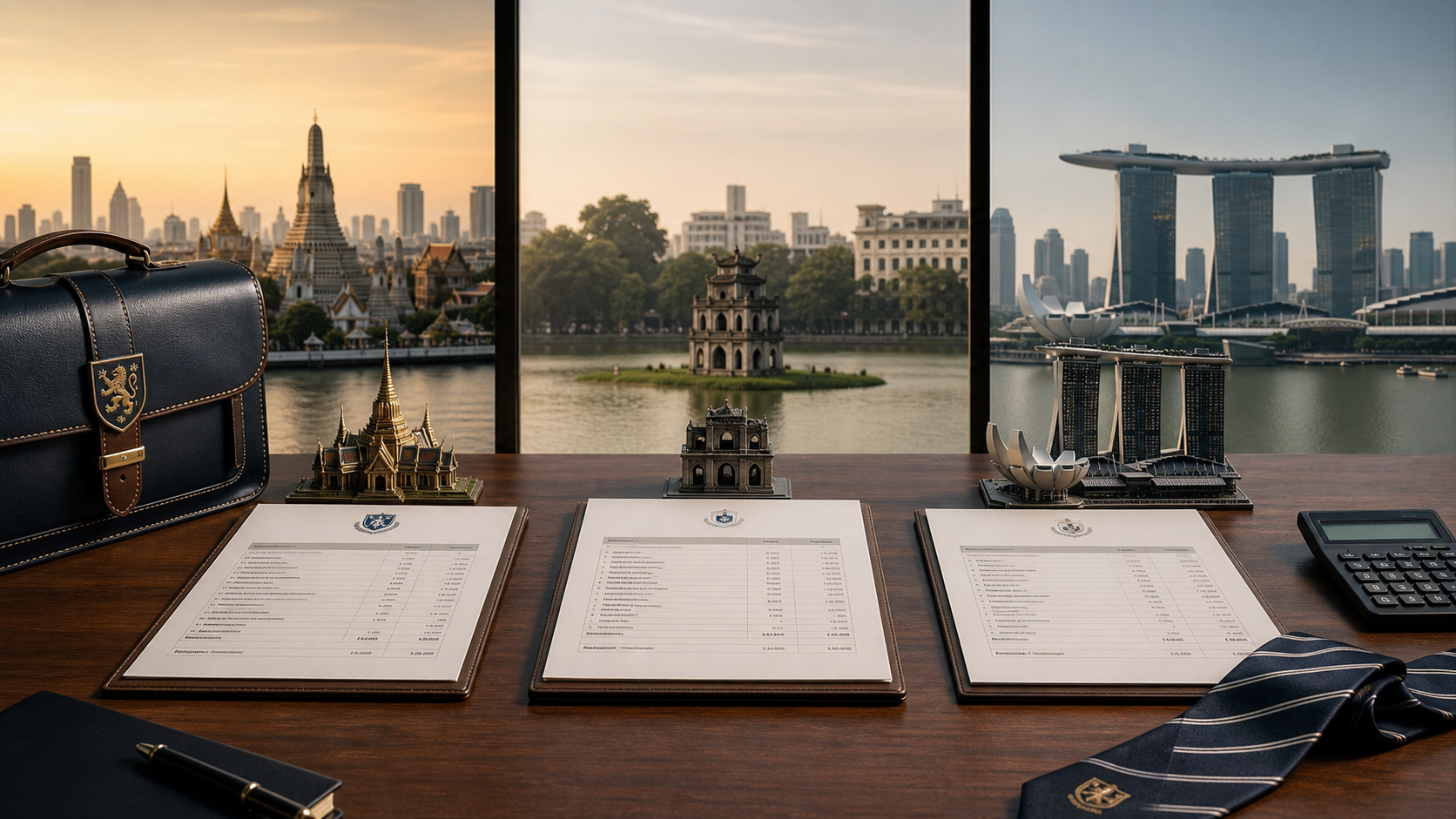
There’s a pattern in expat family WhatsApp groups across Asia that anyone who’s been in one for more than five years will recognise.
A new family arrives. They post asking about school recommendations. The replies come quickly with the usual suspects: Bangkok Patana, BIS Hanoi, Tanglin Trust, depending on the city. The new family does their visits, signs up, posts a cheerful update about their first day.
Three years later, the same parent posts something different. “Has anyone else seen their fees go up 6% again this year? We’re really feeling it. Considering whether we can keep going through senior school.”
Five years in, the post changes again. “We’re looking at moving the kids back to the UK for senior school. The fees have just got too much.”
This is the fee inflation trap. It’s not a feature of any single school. It’s a structural pattern across the entire premium international school market in Asia, and it has caught out British expat families consistently for at least fifteen years. Today’s piece is the deep look at why fees rise the way they do, what 13 years of compounding actually means in pound terms, and the structural reasons families find themselves trapped once they’re inside the system.
The maths are worse than most parents realise. Once you understand the pattern, the decisions you make today look different.
The baseline numbers
Across published guides and school fee schedules in 2025-2026, the typical annual fee inflation reported across Asian international schools is 3-5% for the broad market and 5-7% for the premium private equity-owned chains. Some schools have raised fees by 7-9% in single years, particularly post-COVID and during periods of construction debt servicing.
For comparison:
- UK CPI inflation 2026 forecast: 2.3-2.7%
- Thai inflation 2024-2025: 0.8-1.5%
- Vietnamese inflation 2024-2025: 3.0-3.5%
- Singapore inflation 2024-2025: 2.0-2.5%
The international school inflation rate runs at roughly double local inflation in every major Asian city. This is not a function of underlying cost pressures alone. As established in Day 7, the cost structure of international schools includes substantial categories (regional headquarters, debt servicing, shareholder returns) that demand growth in revenue independent of local inflation. Fees rise because the institutional pyramid demands they rise.
The 13-year compound effect
Here’s where the maths gets uncomfortable. Take a child enrolled in Year 1 at a Bangkok mid-tier international school in 2026. Annual tuition: £18,000 (a representative figure for a school like Bangkok Patana’s lower primary, NIST primary, or St Andrews Bangkok).
At 5% annual fee inflation, the same year group at the same school in subsequent years looks like this:
| Year | Year group | Annual fee | Cumulative paid |
|---|---|---|---|
| 2026 | Year 1 | £18,000 | £18,000 |
| 2027 | Year 2 | £18,900 | £36,900 |
| 2028 | Year 3 | £19,845 | £56,745 |
| 2029 | Year 4 | £20,837 | £77,582 |
| 2030 | Year 5 | £21,879 | £99,461 |
| 2031 | Year 6 | £22,973 | £122,434 |
| 2032 | Year 7 | £24,122 | £146,556 |
| 2033 | Year 8 | £25,328 | £171,884 |
| 2034 | Year 9 | £26,594 | £198,478 |
| 2035 | Year 10 | £27,924 | £226,402 |
| 2036 | Year 11 | £29,320 | £255,722 |
| 2037 | Year 12 | £30,786 | £286,508 |
| 2038 | Year 13 | £32,325 | £318,833 |
By Year 13, the annual fee has risen to £32,325, almost 80% higher than the Year 1 figure. The 13-year cumulative cost reaches £318,833.
Now repeat this for a second child starting Year 1 three years later. Same school, same starting age. By the time the second child reaches Year 13 in 2041, the annual fee will have compounded for 16 years from the original 2026 baseline. £18,000 × 1.05^15 = £37,400 for that child’s Year 13.
Cumulative two-child total: roughly £640,000 in nominal pounds over the family’s full school commitment, assuming both children start three years apart.
At 6% annual inflation (typical for private equity-owned chains), the same family’s Year 13 fee reaches £36,200, and the two-child total approaches £720,000 over the full school career.
At 7% inflation (the upper end seen at some premium schools post-COVID), Year 13 fee reaches £40,500, and the two-child total exceeds £800,000.
These are not theoretical projections. They are conservative extrapolations from the actual fee inflation that has occurred at major Asian international schools over the last decade.
What this looks like in real-world cases
Bangkok Patana published its 2018-19 senior school fees at THB 750,000 (approximately £15,800 at the GBP/THB rate then). Its 2025-26 senior school fees range up to THB 880,000 (approximately £20,500 at current rates). Over seven years, that’s a 17% increase in baht and a 30% increase in sterling, reflecting both fee inflation in baht and the pound’s weakness against the baht.
For a family who enrolled their first child in Year 7 in 2018 with a senior school plan, the senior school fees they actually paid by 2024 were roughly 30% higher in sterling than they had budgeted at enrollment.
BIS Hanoi (Nord Anglia) similar pattern. Mid-tier US dollar fees in 2018-19 were around USD 16,000-20,000 for senior years. Today’s range is USD 24,000-28,000. That’s a roughly 40% increase over seven years, well above Vietnamese inflation over the same period.
Tanglin Trust Singapore in 2019 charged senior school fees of approximately SGD 41,000-43,000. Today the same year groups charge SGD 48,000-50,000. A 17-20% increase over six years in Singapore dollars, on top of which sterling has weakened against SGD over the same period.
The pattern is consistent. Asian international school fees compound at 4-6% per year in local currency. For British families, the sterling impact is worse because the pound has been structurally weak against most Asian currencies.
Why families don’t see this coming
There are three structural reasons British expat families consistently underestimate the long-term fee burden when they first commit.
One: schools market the year-one fee. When you visit a school, the fee schedule shown is the current year. Future fees are described as “subject to annual review” with vague language about inflation. No school publishes a 13-year projection of where its fees will be by the time your reception-age child reaches Year 13. Most families don’t ask, and the assumption is that fees will rise gently with inflation. They don’t.
Two: employer education allowances rarely keep pace. If your relocation package includes an education allowance of £30,000 per child per year, that figure typically does not auto-escalate with school fee inflation. Your employer adjusts it during salary reviews, which generally lag school fee increases by 2-4 years. Over 13 years, this gap compounds. A family that arrives with full allowance coverage in Year 1 often finds themselves paying £10,000-£15,000 per child out of pocket by Year 10.
Three: the sunk-cost trap. By Year 5 or 6, your child has friends, teachers, sporting commitments, and a school they call home. The cost of moving them rises sharply with each passing year. Schools know this. They can raise fees aggressively in the senior years because the cost of moving a Year 10 student to a different school is genuinely high, both financially (new entrance fees, capital contributions, possible loss of deposits) and emotionally (disruption at GCSE/IB Diploma stage).
The result is what economists would call lock-in. Once you’re three years into a school, you’re effectively committed to whatever fee inflation that school chooses to impose for the next ten years.
The senior school cliff
There’s a specific feature of international school fees that British families often discover only when they hit it. The senior school fee jump is dramatically larger than the annual inflation rate suggests.
At Bangkok Patana, primary school (Year 6) fees are around THB 620,000. Senior school (Year 7) fees jump to roughly THB 780,000. That’s a 26% single-year increase just for moving from primary to secondary, on top of the 5% annual inflation.
The pattern repeats at the IB Diploma / A-Level transition. Year 11 fees at Patana are around THB 820,000. Year 12 (IB Diploma) jumps to THB 880,000+. Another 7-10% step-up.
Across a child’s school career, the actual fee acceleration is steeper than smooth 5% annual inflation would suggest. Years 1-6 inflation looks gentle. Year 7 jumps. Years 7-11 inflation continues at 5%. Year 12 jumps again. Year 13 finishes high.
Families who budget for “fees rising at 5% per year” without modelling the senior school steps consistently underestimate the total by 15-25%.
The currency overlay
For British families, there’s an additional layer. The figures above are all in local currency. Sterling has been weakening against most Asian currencies for years.
GBP/THB has moved from approximately 50-55 baht (2019) to 43-44 baht today. That’s roughly a 15-20% sterling weakening over six years.
GBP/SGD has been more stable but still slightly weaker.
GBP/VND has held more steady because Vietnam’s currency is more actively managed.
For a British family paying school fees in Thai baht, the effective sterling cost of fees has risen by both local fee inflation (around 5% per year) and sterling weakness (around 2-3% per year compounded), giving an effective sterling fee inflation rate of 7-8% per year.
Over 13 years at 7.5% effective sterling inflation:
£18,000 × 1.075^12 = £42,800 by Year 13 in sterling terms.
That’s a real-world fee escalation that most British families never seriously model. The combination of local fee inflation and sterling weakness compounds to roughly 2.4x the original starting figure over a full school career.
The total cost picture, properly modelled
Let’s put this all together. A British family with two children enrolled at a Bangkok mid-tier international school starting in 2026:
Child 1: Year 1 fee £18,000, starts 2026, finishes 2038. Cumulative 13-year sterling cost at 7.5% effective inflation: roughly £365,000-£395,000.
Child 2: Year 1 fee £21,000 (assuming child 2 starts in 2029 at a higher baseline due to inflation), starts 2029, finishes 2041. Cumulative 13-year sterling cost: roughly £420,000-£460,000.
Family total: £785,000-£855,000 across the full school commitment, in nominal sterling.
Add the hidden fees and capital contributions (which we’ll cover in the next piece, but which typically add £20,000-£50,000 per child), and the realistic family total approaches £900,000-£1 million for two children’s full school careers at a mid-tier Bangkok international school.
This is for a school we previously categorised as “value tier” in the city comparison. The premium British schools (Harrow Bangkok, Shrewsbury) push this figure to £1.1m-£1.3m. Singapore equivalent: £1.4m-£1.7m.
These are the numbers that British families need to be modelling when they consider relocation to Asia with school-age children. They are dramatically higher than the year-one fee schedules suggest.
The schools’ defence and the structural reality
International schools defend their fee inflation rates with three arguments, each of which has some merit and significant problems.
One: “Teacher salaries are rising globally.”
Partly true. International teacher recruitment is genuinely more competitive than a decade ago, and salaries for senior teachers at premium schools have risen. But teacher salaries have not risen at 5-7% per year for the last decade. They’ve risen at 2-4% in most cases. The gap between teacher salary inflation and fee inflation is the part that flows to other budget categories.
Two: “Facilities require continued investment.”
Partly true. Premium international school campuses are extensive and require ongoing capital expenditure. But facilities investment is rarely the largest category in operating budgets, and the fee inflation rate consistently exceeds what would be needed to maintain facility quality. The excess flows to management overhead, marketing, and shareholder returns.
Three: “Quality requires investment.”
This is the marketing line. It’s also the hardest to verify. There is little objective evidence that the educational quality at premium international schools has improved at the same rate as fees have risen. Examination results, university destinations, and student satisfaction surveys are roughly comparable to a decade ago. The “quality” being paid for is largely brand positioning, not measurably better education.
The honest structural reality, as established in Day 7, is that international school fees rise faster than inflation because the institutional pyramid that absorbs them is structurally inflationary. Regional headquarters costs, private equity debt servicing, and shareholder return expectations all demand revenue growth. Fees rise because the system requires them to.
What parents can actually do
The fee inflation trap is structural, but it’s not unavoidable. Three concrete recommendations:
Model the full 13-year cost at realistic inflation rates before committing. Most families budget based on the current year’s fee schedule. Use 6-8% effective sterling inflation as your planning assumption, not 3-5%. The honest 13-year per-child cost for a Bangkok mid-tier international school is £300,000-£400,000 in nominal sterling, not the £230,000 that flat-rate fee projections produce.
Build “fee escape” optionality into your relocation planning. Specifically: don’t sell your UK property when you move to Asia, especially if you have school-age children. The option to relocate the family back to the UK in Year 7 or Year 10 if fees become unaffordable is worth preserving. Families who burnt their UK ships in Year 1 often find themselves trapped at Year 10 paying fees they can’t sustain.
Negotiate education clauses in employment contracts with proper indexation. A common but costly mistake: accepting a fixed-amount education allowance that doesn’t escalate with school fee inflation. Insist on indexation language that ties the allowance to a published school fee schedule or to local CPI plus a premium of at least 3%. Most employers will accept this if asked, but few offer it by default.
Consider non-profit foundation schools and bilingual alternatives more seriously. As established in earlier pieces, foundation schools (Bangkok Patana, Tanglin Trust, UWCSEA) have meaningfully slower fee inflation than private equity-owned chains. Bilingual schools have much lower starting fees and slower inflation. Both options reduce the long-term fee escalation problem.
The takeaway
International school fees in Asia rise at 4-6% per year in local currency, with the premium private equity-owned chains running at the upper end. For British families, the effective sterling fee inflation rate is 7-8% per year due to sterling weakness against Asian currencies. Compounded across a 13-year school career, this means starting fees of £18,000 reach £35,000-£43,000 by Year 13.
The 13-year cumulative sterling cost for a single child at a Bangkok mid-tier international school is £350,000-£420,000. For two children spaced three years apart, the family total is £780,000-£860,000. Premium British schools push this to £1.1m-£1.3m. Singapore equivalent: £1.4m-£1.7m.
Most British expat families never model this properly before committing, then find themselves locked into a fee escalator they can’t escape. The schools know this, which is why they can raise fees aggressively in the senior years where the cost of moving children is highest.
The structural fix exists. Non-profit foundation schools and bilingual alternatives have meaningfully lower starting fees and slower fee inflation. Choosing these schools at the start of a child’s education saves £300,000-£600,000 over the full school career compared to defaulting to the premium private equity options.
In the next piece, we’ll look at the catalogue of hidden fees and capital contributions that add another £20,000-£50,000 per child beyond the headline tuition. After that, the demographic shift inside international schools, the teacher quality and turnover question, and the final pillar piece on how British families should actually navigate all of this.
The cumulative argument across this pillar remains the same. The international school economy in Asia is structured to extract maximum value from British expat families on the assumption that they won’t model the long-term costs, won’t ask the structural questions, and will keep paying because their employers expect them to. Modelling the actual numbers, properly, is the single most valuable thing a family can do before committing.
Today’s piece has provided the numbers. At 5-7% annual fee inflation compounded over 13 years, with sterling weakening against Asian currencies, you should expect to pay 2-2.4x your year-one fee by the time your child finishes Year 13. Build that into your planning, or accept that the trap is real.